Cricket Scorekeeping: How to Read the Book, Board, and Live Score
Cricket scorekeeping makes runs, wickets, overs, and extras easier to read, so you can compare a scorebook with a ground board or live feed confidently.
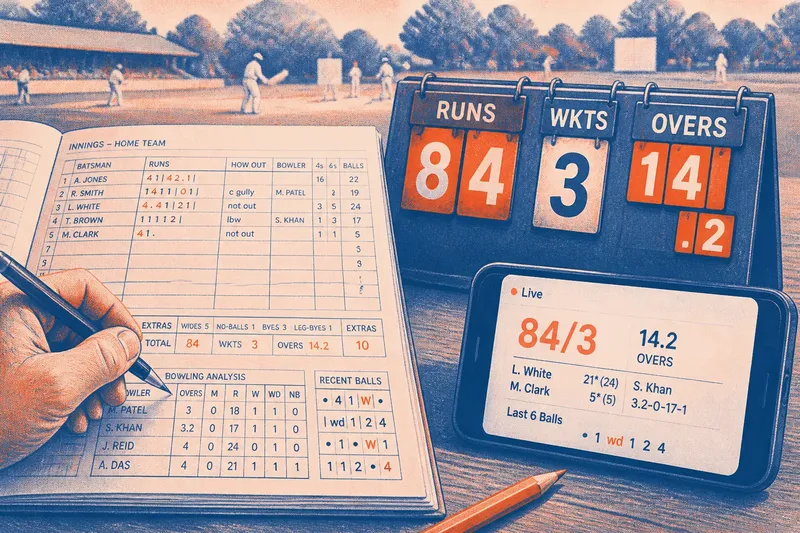
Cricket scorekeeping makes a match easier to follow when you know what each display leaves in and leaves out. A scorebook records the innings in detail; a ground board gives spectators a quick snapshot; a live score can carry updates beyond the boundary. Reading the three together turns a changing total into a story you can track.
What does a scorebook record?
A scorebook gives the scorer space to record the batting order, each batter’s runs, the team total, wickets, extras, and bowling figures. The exact layout and shorthand vary, so check the book’s key or the competition’s scoring conventions rather than assuming every mark is universal.
The entries connect, but they are not interchangeable. A boundary credited to a batter adds to that batter’s score and the team total. A wicket records a dismissal but does not add runs. Extras such as wides, no-balls, byes, and leg-byes contribute to the team total without necessarily being credited to a batter.
A scorebook also preserves sequence. It can show how an innings developed, not just where the total stands now. That detail is useful when a brief display leaves a question about who scored, how a wicket fell, or why the team total differs from the batters’ combined runs.
Why use a manual ground board?
A paper record is useful beside the scorer, but spectators across a ground need a visible summary. A manual board uses cards, tiles, or panels to display selected information, commonly the innings total and wickets. Depending on its layout, it may also show overs or batter names.
The board’s job is speed and visibility, not a full account of every delivery. A total and wicket count can show the broad state of an innings, but they cannot explain whether the runs came from boundaries, singles, or extras. A manual update may also follow the event by a short interval while someone changes the display.
Imagine a club match in which the board shows 42 for one while the scorer is entering a new boundary in the book. The book now contains the latest event, but the board still shows the earlier total. Once the attendant changes the number, both records agree; until then, the board is a useful snapshot, not the newest entry.
What can a digital scoreboard show?
A digital scoreboard can combine the total, wickets, overs, batter scores, bowling figures, and recent deliveries on one screen. It can switch between views for people in the ground, while a live score page or broadcast graphic can serve viewers elsewhere. More fields offer more context, but different displays may refresh at different times.
The scorebook remains valuable because it preserves the sequence behind those summaries. The digital display answers, “Where is the innings now?” The scorecard helps answer, “How did it get there?” If the two differ, check the competition’s official score first and allow a brief pause for displays to refresh.
How do you read the score and overs?
In a score such as 84 for three, the first figure is the team’s runs and the second is the number of wickets lost. An overs figure such as 14.2 means fourteen completed overs and two legal balls of the next over. The digit after the dot is a ball count, not a decimal fraction.
Legal deliveries advance the ball count. A wide adds a run to the team total and requires another delivery, but it does not count as one of the legal balls in the over. This distinction explains why a total can rise while the overs-and-balls figure stays unchanged.
- Check the total and wickets: If both appear, read them together to see how many runs the team has and how many batters have been dismissed; if the wickets are missing, look for a fuller scorecard before judging the innings.
- Check the overs notation: If the figure ends in a ball count within the current over, read it as legal balls rather than a decimal; if that count seems inconsistent with the latest delivery, wait for an update or consult the official score.
- Check batter runs against the team total: If the total is higher than the batters’ combined runs, extras may account for the difference; if the gap remains unclear, inspect the scorecard’s extras entry.
- Check the source and update time: If a ground board or phone screen appears behind the official score, use the current competition score as your reference; if sources still disagree, give them time to refresh before drawing a conclusion.
- Check the delivery classification: If a ball is called wide or no-ball, expect an extra and no increase in the legal-ball count; if the display advances the count, verify the latest official entry.
- Check whether the score was corrected: If the official score changes after review, use the revised figure; if only one secondary display changes, wait for confirmation before treating it as settled.
Why can two cricket scores disagree?
A match event must be classified, entered, and then passed to the board or feed. Those updates do not always appear at the same moment. A wide, for example, adds a run to the team’s total and calls for another delivery, while leaving the legal-ball count unchanged. A display may show the extra run before its overs field has refreshed.
Imagine a scorecard reads 84 for three after 14.2 overs, while a phone briefly shows 14.3. The starting inputs are the same total and wicket count, but the ball figures conflict. Check the latest delivery in the official score: if it was a legal ball, 14.3 may be right; if it was a wide, the legal-ball count should remain at 14.2 while the extra run is added. The comparison identifies which field needs an update rather than treating the mismatch as a different match event.
Corrections can also change a displayed figure when the scorer or official clarifies how an event should be recorded. A revised score is not automatically evidence of carelessness; it may reflect a corrected classification. For a spectator, the useful question is whether the official record now presents a consistent total, wicket count, and overs figure.
Which score should you trust, and what do common symbols mean?
Which display should I trust first?
Start with the official score provided by the match organizer or competition, especially if a broadcast graphic and a phone screen differ. Give other displays a moment to refresh before treating a temporary mismatch as settled.
Why can the total change without a batter’s score changing?
Extras can add runs to the team total without being credited to a batter. Wides and no-balls are familiar examples, while byes and leg-byes are recorded separately from batter runs.
What does the digit after the dot in overs mean?
It counts legal balls bowled in the current over, after the completed overs. A figure ending in .4 means four legal balls beyond the completed overs, not four tenths of an over.
Why might a scorecard show more than a ground board?
A scorecard can include batting and bowling figures, dismissals, and extras, while a ground board favors a readable snapshot. Use the board for the broad state of play and the scorecard when you need the detail behind it.
How does cricket scorekeeping help you follow a match?
Cricket scorekeeping is easiest to read when you match each tool to its purpose: the book preserves detail, the ground board makes selected figures visible, and the live score carries updates to other viewers. When a number changes, check the neighboring fields too. A rising total with unchanged wickets suggests a different development from a new wicket beside a modest total.
That small habit helps you spot both the shape of an innings and a display that may still be catching up. If the figures do not fit together, consult the current official scorecard; it can show the event behind the number rather than asking the scoreboard to tell the whole story.